
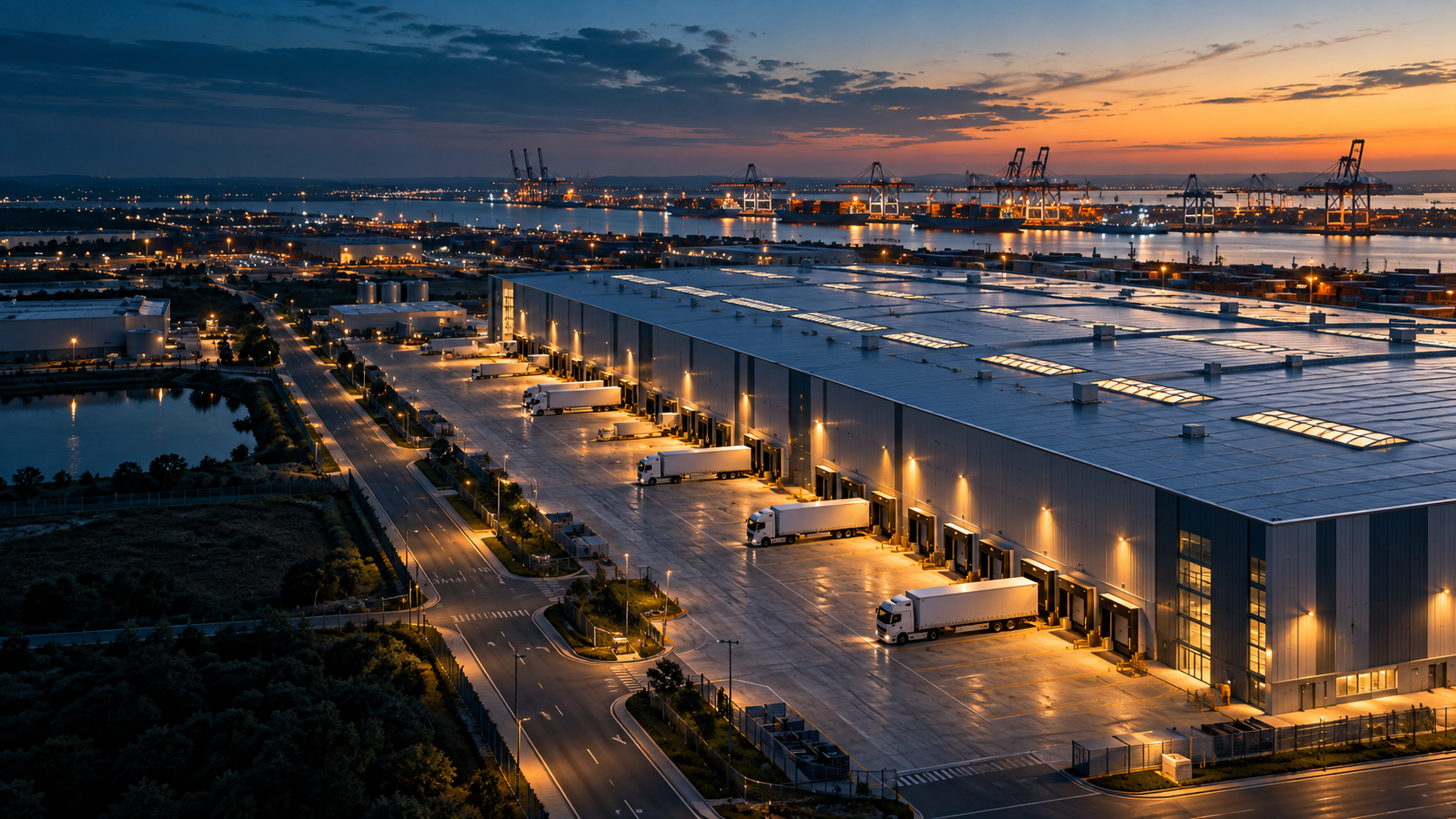
Warehousing as a Real-World Asset: Institutional Underwriting, Tokenization Mechanics, and Comparative Allocation Against Farmland
Executive Thesis: From Biological Yield to Supply Chain Throughput
Institutional capital allocation into tangible Real-World Assets (RWAs) has historically bifurcated into natural resource endowments—exemplified by agricultural land—and income-producing commercial infrastructure, led in the modern era by industrial and logistics warehousing1. While farmland and warehousing share foundational real asset characteristics, including tangible asset backing, recurring cash yields coupled with long-term capital appreciation, and inflation pass-through capabilities, they occupy fundamentally different positions on the macroeconomic risk-return spectrum1. Farmland functions as a defensive, low-volatility store of value anchored by biological productivity, non-depreciable soil scarcity, and inelastic global food and fuel consumption3. Warehousing, conversely, operates as an economic throughput engine and a high-conviction play on e-commerce fulfillment, supply chain regionalization, inventory buffering, and industrial automation2.
A rigorous examination of multi-decade performance data alongside 2025–2026 market realignments reveals a critical structural convergence. Over the 1992–2025 cycle, private U.S. farmland tracked by the National Council of Real Estate Investment Fiduciaries (NCREIF) generated an annualized return of 9.84% with a standard deviation of 6.94% and a Sharpe ratio of 1.02, outperforming broader commercial real estate (7.53% annualized return, 7.93% volatility, 0.60 Sharpe ratio), timberland (8.54% return, 8.31% volatility, 0.69 Sharpe ratio), gold (7.66% return, 17.55% volatility, 0.28 Sharpe ratio), and U.S. bonds (4.51% return, 5.39% volatility, 0.32 Sharpe ratio), while nearly matching U.S. equities (10.73% return, 0.46 Sharpe ratio) and public U.S. REITs (9.10% return, 0.34 Sharpe ratio) at less than half their respective volatilities (17.36% and 18.56%)8. However, the narrative of farmland as an asset class immune to cyclical drawdowns fractured in 2024 and 2025. Following three decades without a negative annual print, the NCREIF Farmland Index recorded its first negative annual total return of -1.03% in 2024 (+2.49% income return offset by -3.46% capital depreciation), followed by a near-flat +0.20% total return in 2025 (+3.05% income offset by -2.85% appreciation) and +0.27% in the second quarter of 2026 (+0.57% income, -0.30% appreciation)9. Elevated borrowing costs, softer row-crop commodity prices, and severe valuation write-downs in water-constrained permanent cropland—such as a 20.4% decline in California permanent cropland values between 2018 and 2024—exposed how infrequent, appraisal-based accounting had historically smoothed farmland's underlying economic volatility9.
Asset Class / Benchmark (1992–2025 & 2024–2026 Regime Shift) | Long-Term Annualized Return (1992–2025) | Annual Return Volatility (Std. Dev.) | Sharpe Ratio (1992–2025) | Recent Cycle Performance & Repricing Metrics (2024–2026) |
|---|---|---|---|---|
Farmland (NCREIF Farmland Index) | 9.84%8 | 6.94%8 | 1.028 | -1.03% total return in 2024 (+2.49% income, -3.46% appreciation); +0.20% in 2025 (+3.05% income, -2.85% appreciation); +0.27% in Q2 20269. |
Commercial Real Estate (NCREIF NPI) & Industrial Warehousing | 7.53% (Broad NPI)8 | 7.93%8 | 0.608 | NPI Industrial sub-index returned 13.7%–15.6% (5–10 yr peak) and 4.4%–4.6% in 2025–Q1 2026; Q2 2026 NPI total return at 1.29%10. |
Public U.S. REITs & Industrial Logistics REITs | 9.10% (All U.S. REITs)8 | 18.56%8 | 0.348 | FTSE Industrial REITs returned +17.05% in 2025 (+5.27% YTD Sept 2026); Prologis Q3 2026 net effective lease spread +38.0% (+23.4% cash); STAG Q2 2026 straight-line spread +33.7% (+19.8% cash)17. |
U.S. Stocks (S&P 500) | 10.73%8 | 17.36%8 | 0.468 | High equity volatility; -0.06 long-term correlation to NCREIF Farmland (1994–2024)8. |
Timberland (NCREIF Timberland Index) | 8.54%8 | 8.31%8 | 0.698 | Q2 2026 quarterly return of +0.95% (+0.34% income, +0.61% appreciation)10. |
Gold | 7.66%8 | 17.55%8 | 0.288 | Commodity store of value; on-chain tokenized commodities expanding in 20268. |
U.S. Bonds | 4.51%8 | 5.39%8 | 0.328 | Pressured by higher-for-longer 10-year Treasury yields near 5.33% in 20268. |
In contrast to farmland's late-cycle deceleration, industrial warehousing absorbed its interest-rate-driven valuation reset earlier between late 2022 and 2024—when core open-end commercial real estate indices (NCREIF ODCE) adjusted downward by roughly 19%—and reached a decisive operational inflection point in 20261. Because commercial warehouse leases typically run for 5 to 10 years with fixed annual escalators of 2% to 4%, leases signed prior to the 2020–2022 logistics boom sit substantially below current market rates24. As these legacy contracts roll over in 2026, institutional warehouse landlords are capturing extraordinary mark-to-market repricing: Prologis recorded a 23.4% cash rent change and a 38.0% net effective rent change in the third quarter of 2026 (following 36.9% in Q2 and 43.8% in Q4 2025), while STAG Industrial achieved a 19.8% cash rent spread and a 33.7% straight-line rent spread across its operating portfolio in the second quarter of 202618.
When translated into the Real-World Asset (RWA) and blockchain tokenization ecosystem—which expanded past $33.5 billion in on-chain distributed value (excluding stablecoins) by July 2026—this structural divergence makes warehousing a uniquely compelling counterpart to tokenized agriculture2. Whereas tokenized farmland must bridge seasonal harvest volatility, variable input costs, irrigation capital expenditures, and complex commodity custody into decentralized finance (DeFi)28, a Triple Net (NNN) logistics warehouse converts physical square footage into a programmable, bond-like corporate credit stream2. Because creditworthy logistics occupiers (such as Amazon, DHL, FedEx, and Walmart) assume direct responsibility for property taxes, building insurance, and Common Area Maintenance (CAM) under multi-year NNN structures, the net operating income (NOI) flowing into a tokenized Special Purpose Vehicle (SPV) exhibits minimal expense leakage and high smart-contract automation reliability2.
Structural Comparison: Warehousing vs. Farmland as Real Assets
Evaluating warehousing alongside farmland requires deconstructing how each asset class generates cash flow, absorbs inflation, utilizes leverage, and manages physical depreciation. While both provide portfolio diversification, their underlying microeconomic mechanics are nearly inverted1.
Structural Dimension | Industrial & Logistics Warehousing | Agricultural Farmland (Row & Permanent Crops) |
|---|---|---|
Primary Demand Drivers | E-commerce fulfillment (3x space multiplier vs. brick-and-mortar), 3PL outsourcing, nearshoring/manufacturing, inventory buffering6. | Inelastic global consumption of food, fiber, and biofuel mandates (e.g., corn ethanol); independent of business cycles3. |
Supply Elasticity | Elastic over multi-year cycles (252–324 msf under construction in U.S. in 2026), but constrained in urban infill, coastal gateways, and IOS by zoning and power5. | Strictly inelastic and shrinking; over 11 million U.S. acres permanently lost to urban sprawl over the past two decades3. |
Historical Total Return (NCREIF) | 7.53%–9.02% (Broad NPI 20–30 yr); Industrial sub-index 13.7%–15.6% (5–10 yr through peak), normalizing to 4.4%–4.6% in 2025–Q1 20268. | 9.84%–11.0% annualized (NCREIF Farmland Index, 1991–2025), decelerating to -1.03% in 2024, +0.20% in 2025, and +0.27% in Q2 20268. |
Going-In Cash Yield / Cap Rate | 4.25%–5.75% Prime Global Cap Rates (5.2% U.S. Prime avg); 6.0%–7.88% Secondary, Cold Storage, and Sale-Leaseback cash yields19. | 2.8%–5.0% gross/net cash rent yield (2025 USDA national cropland average cash rent of $161/acre on $5,830/acre value = 2.8% gross; NCREIF 2025 income = 3.05%)3. |
Historical Volatility & Correlations | 6.00%–7.93% unlevered appraisal volatility (higher in public REITs at 18.56%); cyclical correlation with GDP and freight volume1. | 6.84%–6.94% standard deviation; -0.06 correlation to S&P 500 (1994–2024) and +0.70 to +0.97 correlation to CPI inflation8. |
Dominant Lease Structure | Triple Net (NNN) and Absolute Net (5–15 years) with 2%–4% fixed annual escalators or CPI adjustments; tenant pays taxes, insurance, and CAM2. | 1–3 year Fixed Cash Rent, Crop Share (50/50 split of yield and inputs), or Flex Cash Lease (base rent floor + revenue/yield bonus)28. |
Capital Expenditure (CapEx) Drag | ~2.0% of asset value annually (roof, structure, HVAC replacement) plus Tenant Improvements (1.65/SF) at rollover4. | <1.0% of asset value annually for row crops (drainage tile, grain storage, irrigation fixed costs below gearhead); higher for permanent orchards4. |
Tax & Depreciation Regime | Improvements depreciable over 39 years; shields rental distributions via return-of-capital classification; eligible for IRS Section 1031 exchanges3. | Raw land is non-depreciable (cash rent is fully taxable ordinary/passive income unless offset by soil/water/tree depreciation); 1031 eligible3. |
Structural Leverage Profile | 30%–70% LTV standard in private CRE (Q2 2026 permanent loan avg LTV at 57.5%; CMBS logistics at 65%–70% LTV)4. | ~15% sector-wide debt-to-asset ratio; low reliance on debt insulates underlying land from forced refinancing liquidations4. |
Institutional Ownership Share | 10%–20%+ across commercial/industrial property types; highly institutionalized with global REITs ($130B Prologis) and mega-funds47. | <1% to 2% of total U.S. farmland acreage/value owned by institutions, despite U.S. farmland being more than twice the size of commercial property sectors combined48. |
Lease Architecture and Cash Flow Pass-Through Mechanics
The primary operational advantage of warehousing as an RWA lies in the contractual standardization of the Triple Net (NNN) lease24. Under an industrial NNN agreement, the tenant pays base rent alongside its proportionate share of three pass-through categories: property taxes, building insurance, and Common Area Maintenance (CAM), which encompasses parking lot upkeep, exterior lighting, landscaping, and snow removal24. In standard NNN structures, the landlord's financial obligation is restricted to long-lived structural components—specifically the roof, foundation, exterior building envelope, parking lot structure, and main HVAC unit replacement—while the tenant maintains everything inside the leased premises, including floor care, forklift slab damage, dock equipment, quarterly HVAC servicing, and annual fire suppression inspections24. Under an Absolute Triple Net (bond-style) lease, typically deployed in single-tenant sale-leasebacks, the tenant assumes 100% of structural, roof, casualty, and condemnation risks, rendering the landlord's cash flow entirely passive31. Modified gross leases, where certain operating expenses are bundled into base rent, and full-service gross leases remain uncommon in institutional logistics, appearing primarily in older, multi-tenant flex-warehouse parks24.
Farmland leases, by contrast, require active calibration between production risk, commodity price risk, and landowner involvement across three primary contractual archetypes51. In a fixed cash rent lease, the farm operator pays a predetermined dollar amount per acre prior to planting or post-harvest, assuming all weather, yield, and commodity price risk while retaining 100% of government Farm Service Agency (FSA) payments28. While simple to budget, fixed cash rents compress going-in yields—averaging 2.8% nationally per USDA 2025 benchmarks and 3.05% across the NCREIF Farmland Index—and still leave the landowner responsible for property taxes and irrigation fixed costs from the well gearhead and below9. To capture greater upside, landowners may utilize crop-share leases, which are typically structured as a 50/50 split of physical crop yield (or gross revenue) and variable production inputs such as seed, fertilizer, chemicals, and irrigation fuel28. Although crop-share agreements allow landowners to participate immediately in commodity booms without waiting for lease resets, they introduce substantial working-capital variance, require intensive bookkeeping of harvest yields and grain marketing, and expose the investor directly to agronomic failure43. Designed to bridge the tension between operator solvency and landowner upside during periods of volatile input costs, flexible cash leases (flex leases) establish a guaranteed base rent floor supplemented by a post-harvest bonus triggered if gross revenue—calculated as actual yield multiplied by local spot prices—exceeds predetermined non-land production costs plus base rent, commonly splitting excess revenue 50/5028.
This contractual divergence has profound implications for RWA structuring. A warehouse NNN lease shifts operating expense inflation—including rising municipal taxes, surging property insurance premiums, and utility costs—immediately onto the tenant while compounding the landlord's base rent at 2% to 4% annually24. However, if CPI inflation spikes unexpectedly above the fixed 2%–4% escalator during a 10-year lease term, the warehouse landlord's real income lags until the lease expires and resets to market31. Farmland on short 1-to-3-year cash or flex leases reprices almost immediately during inflationary commodity shocks—evidenced in 2022 when stocks (-18.11%) and bonds (-13%) fell simultaneously while the NCREIF Farmland Index gained +9.5% and its Corn Belt sub-index surged +27.99%11. Conversely, when agricultural margins tighten while interest rates remain elevated, farmland operators force immediate rent concessions: Gladstone Land Corporation (NASDAQ: LAND), which owns 144 farms across 98,688 acres, saw its fixed lease payments fall 30.8% in 2025 (from $73.95 million to $51.18 million) while straight-line rents across 14 re-leased farms dropped 7.4% from $427 to $395 per acre41.
Tax Shielding, Leverage Sensitivity, and Productivity Tailwinds
From an after-tax cash flow perspective, warehousing holds a decisive structural advantage over raw cropland due to federal depreciation rules3. Because annual cropland consists almost entirely of unimproved soil, it is non-depreciable; consequently, cash rental distributions are taxed directly as ordinary income unless the property includes depreciable permanent plantings (orchards, vineyards), irrigation equipment, or grain bins3. Warehouse structures and tenant improvements, by contrast, are depreciable over 39 years (or shorter schedules via cost segregation for specialized cold-chain and material-handling installations), allowing institutional funds and REITs to shelter cash distributions3. For example, Blackstone Real Estate Income Trust (BREIT), which holds 20% of its $58 billion net asset value in industrial logistics properties, classified 100% of its 4.6% annualized distribution in 2025 as tax-advantaged return of capital45. Both asset classes remain fully interchangeable as "like-kind" real property under IRS Section 1031, enabling investors to harvest capital gains from appreciated commercial warehouses and roll proceeds tax-deferred into Tenants-in-Common (TIC) farmland portfolios or vice versa3.
However, farmland's lack of depreciation is counterbalanced by its minimal capital expenditure drag and biological productivity compounding. Since World War II, U.S. agricultural crop yields have increased by roughly 2% per year due to advances in seed genetics, precision agronomy, and machinery—all paid for by the farm operator and seed companies rather than the landowner, who spends less than 1% of asset value annually on CapEx4. Warehousing requires approximately 2% annual CapEx reserves to combat physical wear on roofs, dock doors, and concrete slabs, and faces periodic re-leasing friction4. Furthermore, agricultural real estate operates at a conservative ~15% sector leverage ratio compared to 30%–70%+ in commercial real estate, insulating farmland from the debt-service coverage crunches that periodically force leveraged commercial property owners into distressed refinancings4.
Global Warehousing Market Dynamics and Sub-Sector Taxonomy (2026)
The 2026 Supply-Demand Rebalancing and Inflection
Following an unprecedented pandemic-era construction boom that delivered nearly 1 billion square feet of new U.S. industrial supply between Q1 2023 and late 2024, the global logistics real estate market spent 2024 and 2025 digesting excess first-generation inventory58. During that digestion phase, U.S. logistics rents contracted by 6.5% in 2024 and 4.5% in 2025, with coastal markets declining 7.6% and inland markets dipping 3.0% in 202559. By mid-2026, however, industrial fundamentals reached a definitive cyclical inflection point characterized by surging absorption, contracting vacancy, and renewed landlord pricing power6. According to CBRE Q2 2026 figures, the U.S. industrial vacancy rate fell by 20 basis points quarter-over-quarter to 6.5%, marking the first quarterly vacancy decline since Q2 20226. Net absorption reached 85.1 million square feet in Q2 2026, outpacing quarterly construction completions—which fell to a 10-year low of 47.9 million square feet—for the first time in four years6. Cushman & Wakefield's Q3 2026 data confirmed the durability of this expansion, recording 76.6 million square feet of net absorption in Q3 (bringing year-to-date absorption to 203 million square feet) and a 20 bps decline in national vacancy from year-end 2025 to 6.8%35. JLL reported average U.S. asking rents advancing to $10.45 per square foot in Q2 2026, while Cushman & Wakefield tracked Q2 asking rents at $10.32/SF and CommercialEdge recorded in-place rents at $9.20/SF in June 202622.
This operational recovery has been propelled by a pronounced big-box leasing surge and a tenant flight to quality. Total U.S. leasing volume rose 18% year-over-year in H1 2026 to 547.9 million square feet, putting the market on pace to approach CBRE's full-year forecast of nearly 1 billion square feet6. Demand has concentrated heavily in mega-distribution facilities, with leases of 700,000 square feet or larger surging by 125% year-over-year in H1 2026 and 38 leases exceeding 1 million square feet—more than double the H1 2025 tally6. Simultaneously, U.S. warehouse space utilization climbed throughout 2025 and is on track to breach the expansionary threshold of 85.5% in 2026, mirroring the rapid reabsorption trajectories of 2014–2015 and 2021–20225. Conversely, occupiers are abandoning functionally obsolete pre-2000 and pre-2020 facilities, which suffered over 100 million square feet of negative absorption annually in 2024 and 202558. To prevent tenant departures in older buildings, landlords extended early renewal incentives including generous tenant improvement allowances and free-rent periods, prompting tenants to sign renewals an average of 219 days prior to expiration—30 days earlier than in prior years—and pushing renewals above 35% of total leasing volume versus a 24% historical norm61.
Outside the United States, supply-constrained international logistics corridors are exhibiting even tighter fundamentals in 2026. In Europe, strict municipal land embargoes, grid connection caps, elevated construction costs, and low speculative pipelines are driving continent-wide vacancy below 5%, while Dutch logistics investment volume is projected by CBRE to edge up to €2.95 billion in 2026 following a €2.88 billion 2025 recovery5. In Brazil, vacancy across primary hubs (São Paulo and Rio de Janeiro) fell to a decade low of 8.5% in late 2025 and headed toward the mid-7% range, powering a fourth consecutive year of double-digit rent growth in 20265. Meanwhile, India has entered a structural leasing and development boom as institutional capital modernizes regional supply chains beyond Tier-1 metropolitan areas, and Southeast Asia continues to expand at 4.3% to 4.8% annual GDP growth despite global trade realignment5.
Three Structural Multipliers Driving Warehouse Space Demand
Unlike farmland, where demand scales linearly with population growth and caloric or biofuel intake, warehouse demand per dollar of GDP is expanding due to three structural multipliers. The first multiplier is the e-commerce fulfillment and reverse-logistics footprint. Empirical portfolio research by Prologis demonstrates that e-commerce fulfillment requires approximately three times (3x) the logistics floor space per dollar of sales compared to traditional brick-and-mortar retail33. Brick-and-mortar stores replenish via dense palletized freight and store inventory on retail shelves; e-commerce requires 100% of inventory to be warehoused, demands wider SKU depth, relies on labor- and space-intensive individual parcel picking, and necessitates dedicated reverse-logistics processing zones7. Furthermore, shifting from just-in-time to "just-in-case" inventory buffering adds 5% to 10% to baseline inventory carry, requiring an estimated 57 to 114 million square feet of incremental U.S. warehouse space annually7. With 76% of consumers expecting free returns (up from 40% in 2019) and 70% expecting same-day or next-day delivery, e-commerce leasing is approaching 25% of all new global warehouse leases in 2026 as global e-commerce penetration nears 19.7%5. As U.S. e-commerce penetration climbs from 24% toward 30% by 2030—bolstered by cross-border e-commerce platforms that doubled U.S. GMV to $44 billion—this channel shift alone is projected to generate 250 to 350 million square feet of incremental U.S. warehouse demand64.
The second multiplier is manufacturing reshoring, AI infrastructure build-outs, and defense spending. While Third-Party Logistics (3PL) providers remain the largest occupier cohort—accounting for roughly 35% of leasing volume as retailers outsource fulfillment58—domestic and nearshored manufacturing has emerged as the fastest-growing demand catalyst. Cushman & Wakefield reports that manufacturing companies captured over 25% of YTD Q3 2026 U.S. industrial leasing volume35. This surge is propelled by tariff mitigation strategies, national infrastructure spending, the explosive growth of the AI data-center logistics supply chain (projected to nearly double from $17.4 billion in 2025 to $34.1 billion by 2033)66, and a structural rearmament wave across the U.S. and Europe, where NATO members are raising defense commitments from 2.5% toward 5% of GDP, revitalizing heavy-power industrial corridors in Germany, France, Italy, the UK, the Netherlands, Poland, Los Angeles County, and Fairfax County, Virginia5. Along the U.S.–Mexico border, cross-border manufacturing propelled El Paso, Dallas-Fort Worth, Houston, and Phoenix to the top of U.S. net absorption rankings in 2026, while Mexico's 3PL market expanded from $15.3 billion in 2025 to $16.6 billion in 2026 on a 6.27% CAGR trajectory toward $27.0 billion by 2034 (with Mexico's e-commerce warehouse market growing at a 5.29% CAGR to $1.38 billion by 2031)6.
The third multiplier is transportation cost arbitrage and the price inelasticity of warehouse rent. In total supply chain economics, warehouse rent represents only ~5% of total logistics spend, whereas transportation, trucking, and drayage account for the vast majority7. In 2026, U.S. active trucking carrier authorities sit 12% below their 2022 peak due to driver attrition, multi-year freight margin compression, and stricter federal regulatory enforcement (including English-language proficiency mandates), while transportation M&A consolidation accelerated to 93 deals totaling $57.9 billion in H1 20255. These supply constraints pushed national freight tender rejections 136 bps above 2024 levels and triggered double-digit freight rate hikes in 20265. Because a 10% increase in trucking costs dwarfs a 10% increase in warehouse rent, occupiers exhibit low price elasticity for well-located infill warehouses that shorten last-mile delivery routes, and coastal gateway rent spreads returned to pre-pandemic relative value in late 2025, driving a three-year high in coastal demand in 20265.
Global Cap Rate Benchmarks and Sub-Sector Economics
In early 2026, higher-for-longer sovereign interest rates drove a 15 to 40 bps year-over-year expansion in indicative prime industrial capitalization rates across major global markets, bringing the U.S. prime average to 5.2%, New Zealand to 5.0%, and Australia to 4.8% (while U.S. industrial capital markets volume recovered by 15% YoY to a projected $134.6 billion in 2026 and property sales to owner-occupiers rose 32% to $152.42/SF)6. Crucially, investor risk discrimination has widened the spread between prime, institutional-grade assets (long Weighted Average Lease Expiry [WALE], investment-grade covenant, modern specifications) and secondary assets (older stock, shorter WALE, local credit) to an average of 150 basis points globally38.
Beneath headline cap rate averages, warehousing is not a monolithic asset class. Institutional and RWA allocators segment industrial real estate into five distinct sub-sectors, each exhibiting unique construction economics, supply moats, and yield profiles:
Warehouse Sub-Sector | Typical Size & Clear Height | Turnkey Construction Cost ($/SF) | 2025–2026 Vacancy & Rent Dynamics | Representative Yield / Cap Rate Profile |
|---|---|---|---|---|
Bulk Distribution / Mega Big-Box | 250,000 – 1,000,000+ SF; 36 – 40+ ft clear height6. | $85 – 20 – $65/SF basic steel shell)71. | 65% of current construction pipeline; H1 2026 leases 700k SF up 125% YoY; vacancy falling by ~100 bps5. | 4.50% – 5.75% Prime Cap Rate; Prologis Q2 2026 acquisitions at 4.1% stabilized cap rate25. |
Small-Bay / Last-Mile Urban Infill | 5,000 – 50,000 SF; 24 – 32 ft clear height24. | $120 – $200/SF turnkey (elevated urban land basis)72. | 4.8% national vacancy (vs. 7.1% overall); only 0.3% of stock under construction; 15%–25% small-bay rent premium70. | 5.00% – 6.25% Cap Rate; strong mark-to-market protection due to zero new competing supply38. |
Cold Storage / Temperature-Controlled | 50,000 – 300,000+ SF; 36 – 48 ft clear height (high-bay automated)73. | $130 – 241 – $344/SF specialized blast-freeze) — 2x to 3x dry warehouse cost75. | High barrier to entry; sticky food/pharma tenants; EBITDA margins of 20.1% (Americold) to 22.0% (Lineage)78. | 6.20% – 7.88% Cash Yield / Cap Rate (Lineage & Americold REIT yields at 6.2%–6.66%; GNL portfolio sale at 7.88%)39. |
Industrial Outdoor Storage (IOS) | Low building coverage (<20% FAR) on 2 – 20+ acre paved/fenced urban yards36. | Low structural cost, but financially unfeasible to demolish modern buildings to create new yards36. | ~4.0% stable national vacancy; +123% cumulative rent surge since 2020; 18–24 month entitlement battles36. | 5.50% – 7.00% Cap Rate; highest land-value appreciation and lowest CapEx drag in industrial sector36. |
Corporate Sale-Leaseback (Manufacturing / Light Industrial) | 100,000 – 500,000 SF; customized power and crane/floor specs74. | $100 – $220/SF replacement cost; heavy electrical switchgear72. | Driven by PE M&A activity and corporate balance-sheet unlocking; 10–20 year Absolute NNN leases31. | 6.10% – 7.60% Initial Cash Cap Rate (STAG Q2 2026 at 6.1% cash / 6.8% straight-line; W.P. Carey 2025 avg at 7.6%)19. |
A critical second-order insight emerges from comparing Industrial Outdoor Storage (IOS) and Small-Bay Infill to agricultural land. Investors attracted to farmland primarily cite its fixed, non-reproducible supply—since municipalities continuously rezone agricultural land into suburban subdivisions3. Within the industrial ecosystem, IOS and urban small-bay facilities replicate this exact supply inelasticity inside metropolitan boundaries36. Because municipal governments view open equipment and container yards as low-tax-revenue land uses compared to multi-story residential or retail developments, cities fiercely resist granting new heavy-industrial IOS zoning, subjecting applicants to 18-to-24-month entitlement battles while actively rezoning existing industrial yards into mixed-use districts36. Simultaneously, purchasing a fully built warehouse site merely to demolish the structure for outdoor storage is economically prohibitive36. Consequently, grandfathered IOS sites maintain a ~4% vacancy rate, require near-zero building CapEx (much like raw cropland), and delivered a 123% rent surge post-2020—more than triple the 35%–40% rent growth of traditional bulk warehouses36.
The RWA Investment Architecture: Tokenization vs. Traditional Fractional Vehicles
On-Chain Market Scale and Legal-Technical Plumbing
By mid-2026, Real-World Asset tokenization transitioned from experimental proofs-of-concept into institutional production infrastructure83. Across public and permissioned blockchains, tokenized RWAs reached 38.5 billion in distributed asset value excluding stablecoins) in July 2026, with tokenized U.S. Treasuries exceeding $10 billion and private credit, commodities, and real estate forming the next growth wave27. In December 2025, the Depository Trust & Clearing Corporation (DTCC)—which custodies and clears over $114 trillion in traditional securities—secured an SEC no-action letter to pilot tokenizing DTC-custodied assets, signaling mainstream settlement convergence85. Within the real estate vertical specifically, RWA.xyz tracked 229.39 million distributed value across 19,310 wallet holders) as of October 2026, while commercial real estate tokenization leader RedSwan scaled its on-chain commercial portfolio past $5 billion on the Hedera and Stellar networks with a 36-month pipeline targeting $25 billion2. Long-range institutional forecasts project the global tokenized real estate market to reach $3 trillion by 2030 (Boston Consulting Group) and $4 trillion by 2035 (Deloitte), while the real estate tokenization software platform market is projected to expand from $4.93 billion in 2025 to $9.35 billion by 2032 at a 9.8% CAGR, split across debt tokens (39%), utility tokens (32%), and equity tokens (29%)2.
Crucially, neither commercial warehouses nor agricultural farms are tokenized by putting a physical land deed directly onto a blockchain in established legal jurisdictions2. Instead, tokenization places a programmable digital registry layer atop a Special Purpose Vehicle (SPV)2. In the first stage of entity and title isolation, the physical warehouse or farm is placed inside a bankruptcy-remote SPV (such as a Delaware Series LLC, Limited Partnership, or local corporate vehicle), or a minority equity slice—typically 20% to 25% of the capital stack—is syndicated while the lead sponsor retains 75% to 80% ownership and operational management without ceding board seats or triggering restrictive bank covenants2. Subsequently, the SPV issues digital security tokens under established securities exemption wrappers—such as SEC Regulation D (Rule 506c for verified U.S. accredited investors), Regulation S (for non-U.S. investors), Regulation A+ (for non-accredited retail offerings), or European MiFID II and MiCA-aligned frameworks2.
Rather than relying on plain ERC-20 tokens that cannot prevent an investor from transferring a regulated security to an unverified crypto wallet, institutional platforms in 2026 utilize permissioned security token standards that embed compliance directly into smart contract transfer logic84. The dominant institutional architecture is ERC-3643 (the T-REX Protocol developed by Tokeny), which is recognized as a final Ethereum standard with over $32 billion in tokenized assets across 180+ jurisdictions97. ERC-3643 links every token transfer to an on-chain decentralized identity registry (ONCHAINID); before any transfer executes, the smart contract queries both the IdentityRegistry (verifying KYC/AML claims issued by trusted claim issuers) and the ComplianceContract (enforcing jurisdiction caps, investor count limits, and lockup rules), while granting the issuer's transfer agent forcedTransfer and wallet recovery functions to comply with court orders or replace lost private keys97. Alternative standards include ERC-1400, an earlier security token standard family utilizing sub-standards like ERC-1410 (partitions) and ERC-1644 (controller operations) to divide a single property's cap table into distinct tranches—such as senior debt, preferred equity, and common equity—validated via off-chain cryptographic keys97, as well as ERC-7518 (DyCIST), a dynamic, cross-chain interoperable compliance standard pioneered by Zoniqx (deployed with StegX to tokenize over $100 million in institutional CRE on Hedera and the XRP Ledger) that utilizes a modular rule engine for automated multi-chain lifecycle management91.
Comparative Economics of RWA Execution: Warehouse vs. Farmland Platforms
When an allocator evaluates how warehousing and farmland actually perform across digital investment platforms—spanning blockchain-native RWA protocols, crowdfunded private placements, and publicly traded REITs—the operational superiority of industrial warehousing becomes starkly evident. In the Web2.5 fractional farmland sector, platforms such as AcreTrader (acquired by institutional asset manager Proterra Investment Partners in August 2025 after raising $344.7 million to 217 million+ AUM across 51 deals and 6,900+ acres) democratized access to single-farm LLCs and 1031 TIC structures at $10,000 to $50,000 minimums8. Similarly, on-chain DeFi protocols such as LandX—which issues perpetual commodity vault xTokens like xSoy backed by legal crop-share liens alongside cTokens representing physical crops and the LNDX governance token—and Agrotoken, which tokenizes physical grain reserves verified in certified warehouses, attempted to bring agricultural yield on-chain30.
However, empirical 2025–2026 performance data across these agricultural vehicles reveals severe structural friction across fee loads, secondary liquidity, and principal preservation. While AcreTrader advertises a 0.75% annual servicing fee, single-farm offerings layer a 2% to 5% upfront closing and administrative fee and a 5% disposition fee upon farm sale (plus up to 20% crop-revenue incentive fees on select deals), pushing year-one all-in fee drag to 7%–10% of invested principal104. FarmTogether's Sustainable Farmland Fund similarly charges a 1.25% annual management fee, a 2% acquisition fee, and a 15% performance fee above a 6% hurdle, while its bespoke whole-farm accounts ($3 million minimum) levy a 2% one-time administrative fee8. On-chain, LandX extracts a 3% upfront financing fee from farmers, a 0.25% crop-share payment fee, and a 10% tax on USDX yield output106. Compounding these fee burdens is acute illiquidity: despite discussing a secondary marketplace since 2018, AcreTrader still lacked a functioning secondary market as of mid-2026, locking investors into 5-to-10-year holds with annual Schedule K-1 tax delays57.
Even more concerning for agricultural RWA underwriting is the incidence of documented principal losses and credit defaults. Because single-farm SPVs concentrate weather, water, and operator risk without portfolio diversification, downside events have proven severe. Independent 2026 audits of platform outcomes document multiple AcreTrader Australian avocado and citrus farm offerings entering receivership with 100% loss of six-figure investor principal, alongside a "successful" U.S. farm sale that sold above its original purchase price but returned only 43% of investors' $2.8 million equity after satisfying debt and transaction costs104. In the crowdfunded agricultural debt space, Steward—which raised over $44 million offering non-accredited investors a fixed 7.5% monthly yield at a 227,000)—suffered its first catastrophic default in September 2026 when its largest borrower (StarWalker) defaulted on $9.79 million across two loans, representing 29.8% of Steward's entire pooled loan book57. Even liquid public farmland REITs have struggled to translate gross land values into shareholder returns. Over the 2014–2025 decade, while the unlevered NCREIF Farmland Index returned 6.55% annually with 6.02% volatility, Farmland Partners (LAND) returned 1.13% annually (46.48% volatility, -0.016 Sharpe ratio)8. By October 2026, FPI traded at 0.99x book value ($10.47/share, 3.4% yield) after its rental revenue declined 23.7% in 2025 due to liquidating 116 farms for $418.6 million (realizing $92.3 million in net gains) between 2024 and mid-2026 to redeem $68.0 million of preferred units, while externally managed LAND (charging a 0.60% base fee on gross tangible real estate) traded at $9.48/share (5.9% yield) after recording a $23.51 million H1 2026 net loss to common stockholders and expanding its share count by 13.5% in six months41.
Tokenized warehousing resolves the biological, fee, and cash-flow bottlenecks of agricultural RWAs by anchoring the token to long-duration corporate credit2. The unit economics of a standard institutional warehouse tokenization executed in 2026—on a platform such as RedSwan (Hedera/Stellar), Securitize (SEC-registered transfer agent and Alternative Trading System), Tokeny, Zoniqx, or Blocksquare (which converts individual properties into 100,000 standardized Ethereum/IPFS tokens and bridges them to DeFi via Oceanpoint)2—demonstrate high capital efficiency. When an owner of a 2.8 million annual NOI) tokenizes a 25% minority equity stake ($10 million raise), upfront legal SPV structuring, smart contract deployment, and KYC/AML integration cost $80,000 to $150,000 (0.8% to 1.5% of the raise), with ongoing platform administration running 0.5% to 1.5% annually2. Capital formation completes in 4 to 8 weeks—compared to 6 to 12 months for traditional bank syndications—allowing global accredited investors to participate at $1,000 to 700,000 distributed automatically via USDC/USDT smart contracts) plus pro-rata capital appreciation upon refinancing or exit2. Real-world deployments validate this model: RedSwan recently tokenized a fully leased corporate logistics portfolio across Costa Rica's primary industrial hubs, as well as a tokenized limited partnership slice of the Altus Opportunity Fund (comprising industrial, multifamily, and hospitality assets) utilizing the Hedera Token Service with built-in KYC/AML transfer logic2. For yield-oriented credit investors, Centrifuge ($500M+ in tokenized assets) and Maple Finance enable DeFi liquidity pools to finance short-term supply-chain invoices, warehouse inventory receipts, and real estate bridge loans directly on-chain98.
Investment Vehicle Category | Representative Platforms / Tickers | Minimum Investment & Eligibility | Fee Structure | Liquidity Mechanism | 2025–2026 Yield / Return Profile |
|---|---|---|---|---|---|
Tokenized Commercial & Warehouse RWA | RedSwan CRE, Securitize, StegX / Zoniqx, Blocksquare2. | $500 – $5,000 (Reg D Accredited in U.S.; Reg S / MiCA globally)2. | 150k issuer setup; 0.5%–1.5% annual servicing2. | Compliant ATS / DEX (tZERO, Securitize Markets, RedSwan Exchange, Oceanpoint); thin daily volume2. | 6.0% – 8.0% NNN cash yield + 2%–4% annual rent escalators and exit appreciation2. |
Tokenized Farmland & Ag-Commodity RWA | LandX (xTokens / LNDX), Agrotoken105. | ~$10 – $100 (DeFi permissionless or KYC vaults)92. | LandX: 3% financing fee + 0.25% crop share + 10% USDX output tax106. | DEX liquidity pools (subject to smart contract and oracle risks)84. | Target ~10% vault appreciation rate tied to soy, wheat, corn, and rice output105. |
Fractional Private Farmland (Web2.5) | AcreTrader (Proterra), FarmTogether, Steward (Ag Debt), Amber Farmland PBC8. | 50k Accredited (AcreTrader/FarmTogether); $10k Reg A (Amber); $100 Non-Accredited (Steward)8. | 2%–5% upfront + 0.75%–1.25% annual + 5% sale fee or 15% carry41. | Locked 5–10 years; no active secondary market on AcreTrader as of mid-2026104. | 6%–13% target IRR (AcreTrader realized 9.4%–30.3% on 15 exits, but receiverships & Steward's 29.8% book default hit in 2026)57. |
Fractional Private CRE / Industrial Crowdfunding | Fundrise (Flagship / Income), EquityMultiple, RealtyMogul, FNRP, CrowdStreet96. | $10 (Fundrise); $5k (RealtyMogul REIT / EquityMultiple Notes); 50k (Deals/FNRP)96. | 0.5%–1.5% annual asset mgmt + sponsor acquisition/promote fees96. | Deal-locked (3–5+ yrs) or quarterly NAV repurchase capped at 5% (Fundrise)113. | Fundrise Flagship: 1.33% (2025), 5.7% 8-yr avg; Fundrise Income: 8.0%–8.27% (2025)96. |
Non-Listed Institutional NAV REIT | Blackstone Real Estate Income Trust (BREIT — 20% Industrial, 17% Multifamily, Data Centers)46. | Accredited / Qualified Client suitability standards46. | Institutional asset management + performance fee structure46. | Monthly NAV repurchase (subject to monthly/quarterly gating caps)116. | 9.8%–10.4% TTM net return (as of July 2026); 3.7%–4.6% distribution rate (100% ROC in 2025)45. |
Publicly Traded Industrial REITs | Prologis (PLD), EastGroup (EGP), Rexford (REXR), STAG, Terreno (TRNO), Lineage (LINE), Americold (COLD)17. | Price of 1 share (196); open to all retail and institutional investors17. | Internally managed; zero external advisor fees (embedded G&A)41. | Instant T+1 daily stock exchange liquidity (NYSE / NASDAQ)47. | 3.07%–6.66% Dividend Yield (FTSE Industrial REIT avg 3.68%; 2025 sector total return +17.05%; YTD Sept 2026 +5.27%)17. |
Publicly Traded Caribbean Industrial / REITs | Kingston Properties (JSE: KPREIT), Kingston Wharves (JSE: KW), Sygnus Real Estate Finance (JSE: SRF)119. | Price of 1 share on Jamaica Stock Exchange (e.g., KPREIT at J$13.00)121. | Internally or platform managed corporate structures121. | Daily trading on Jamaica Stock Exchange (JSE)120. | KPREIT: 96% occupancy, USD rental revenue +30% in 2025 and +8% in Q1 2026; FY25 net profit US$4.16M121. |
Caribbean and Jamaican Strategic Execution: Nearshoring, SEZs, and Local Vehicles
For capital allocators operating within Jamaica and the wider Caribbean Basin, logistics warehousing represents arguably the highest-conviction real asset opportunity of the 2026–2030 cycle126. While Caribbean agricultural investments frequently confront fragmented land titling, hurricane crop vulnerability, praedial larceny, and sub-scale plot geometry, regional logistics real estate is experiencing an institutional transformation driven by North American nearshoring, Panama Canal transit dynamics, and aggressive Special Economic Zone (SEZ) fiscal incentives126.
The Caribbean Basin Macro-Logistics Landscape (2026)
In 2026, the Caribbean construction market reached $12.4 billion, with the industrial segment (warehouses, manufacturing plants, and oil/gas logistics facilities) accounting for $1.8 billion and expanding at 8.1% annually—despite regional construction material costs sitting 20% to 40% above U.S. mainland prices and skilled trade wages rising 12% to 18%127. Across the region, four primary warehousing corridors have emerged as focal points for institutional capital. Positioned directly along the primary shipping lane connecting the Panama Canal to North American and European markets, Jamaica serves as the premier transshipment and SEZ gateway, anchored by the Port of Kingston's 14.5-meter deep-water draft capable of accommodating Neo-Panamax vessels128. Supported by the $1.5 billion Jamaica Logistics Hub initiative—representing 18% of all Caribbean construction activity in 2026—Jamaica is integrating port terminal operations with contiguous free zones and multi-modal industrial parks, and recently spearheaded the creation of the Caribbean Special Economic Zones Association (CARISEZ) in Panama to coordinate regional trade bloc investment127.
Alongside Jamaica, the Dominican Republic—accounting for 28% of the Caribbean construction market (+6.8% growth in 2026)—has executed a structural pivot from a tourism-dependent economy into an integrated "Logistics Platform State" combining nearshoring, free-zone manufacturing, and cold-chain warehousing across Santo Domingo and Punta Cana126. On May 26, 2026, DP World and the Dominican Government announced a new US13.3 billion in trade in 2024), building directly upon a US$760 million MoU signed in May 2025 to push Dominican goods exports toward $2.4 billion by 2035131. While Law No. 30-24 established a dedicated legal framework for logistics hubs, legal analysts note that systemic institutional coordination and customs clearance predictability remain the critical execution variables132.
In Panama, warehouse demand across the dollarized Colón Free Zone (ZLC)—which handles over 841,700 tonnes of cargo—and Panamá Pacífico surged in 2026 due to two independent supply chain shocks that convert maritime transit bottlenecks directly into terrestrial warehouse absorption129. First, the February 28, 2026 closure of the Strait of Hormuz and concurrent Red Sea/Suez suspensions (affecting 10.7% of global container fleet TEU capacity) forced Asian buyers to pivot heavily to U.S. Gulf Coast LPG and oil suppliers transiting the Panama Canal, causing daily transit auction premiums to triple from 140,000 to 425,000 (peaking at $4 million for the tanker Gas Virgo in April 2026)129. Second, a confirmed late-2026 El Niño prompted the Panama Canal Authority (ACP)—which unveiled an $8.5 billion modernization plan in late 2025—to enact preemptive Neopanamax draft cuts down to 14.78 meters (48.5 ft) by August 2026 alongside shorter 6-month slot allocation cycles under LoTSA 2.0129. Because draft restrictions limit cargo weight per vessel, shipping lines must partially offload containers at Panamanian terminals and hold larger on-land buffer inventories inside Colón and Panamá Pacífico warehouses, where bulk spaces lease from ~4.00/SF/year129.
In the Southern Caribbean, Guyana, Trinidad & Tobago, and Barbados represent specialized energy and humanitarian logistics nodes. In Guyana, over $4 billion in ongoing offshore oil and gas infrastructure drove a regional-leading 12.4% construction growth rate in 2026127. To bypass Demerara River draft limitations and chronic Georgetown wharf congestion, operators like PAS Guyana Inc. opened the country's first off-port bonded warehouse along the Rome section of the Heroes Highway in March 2025/2026, following major shore-base logistics completions by COLI Shipping & Transport78. In Trinidad & Tobago, the Point Lisas Industrial Port Development Corporation (PLIPDECO) manages an 860-hectare industrial estate alongside the adjacent 144-acre Phoenix Park Industrial Estate, offering tenants natural gas supply, underground fiber, and SEZ incentives including a 10-year corporate tax holiday, customs duty exemptions, and 0% VAT on inputs versus the standard 12.5% VAT78. Meanwhile, in Barbados, the World Food Programme (WFP) and CDEMA inaugurated the Caribbean Regional Logistics Hub at Grantley Adams International Airport (2,500 m² covered storage, 1,300 racked pallets, and a 40-TEU container park) to dispatch humanitarian and pharmaceutical supplies within 48–72 hours of regional hurricanes143.
Jamaican Fiscal Regime, Rental Benchmarks, and Investable Vehicles
Under Jamaica's Special Economic Zones Act administered by the Jamaica Special Economic Zone Authority (JSEZA)—which launched its digital real-time SEZ Facilitation Tool on June 11, 2026, alongside a national SEZ Master Plan to eliminate bureaucratic delays—warehousing developers and occupants capture substantial fiscal alpha128. While standard unregulated Jamaican companies face a 25% Corporate Income Tax (CIT) rate (and regulated financial or telecommunications entities face 33.3%), licensed SEZ Developers and Occupants pay a headline CIT rate of 12.5%, which can be compressed to an effective rate of 7.5% to 7.75% through Employment Tax Credits (ETC) and Promotional Tax Credits covering research, development, and staff training up to 10% of tax payable145. For multinational groups exceeding €750 million in global consolidated revenue, allocators must note that this 7.5% effective rate falls below the 15% OECD Pillar Two global minimum tax floor, triggering top-up tax provisions145. Most importantly for RWA structuring, multipurpose SEZ Developers and Occupants are 100% exempt from income tax on profits derived from property rentals within the zone (provided landlord and tenant are not connected persons), and dividend distributions out of zone profits carry a 0% withholding tax rate to both residents and non-residents146. Furthermore, goods and services entering the zone—explicitly including high-cost Jamaican electricity and telecommunications—are zero-rated at 0% General Consumption Tax (GCT) rather than the standard 15% VAT rate146. Developers and Occupants also receive 100% customs duty relief on imported building materials and machinery, exemption from the Assets Tax, 100% Transfer Tax relief for developers selling zone land, and a 50% Stamp Duty reduction on land acquisition alongside a 100% Stamp Duty exemption on leases or sales to SEZ Occupants146. Eligibility requires Jamaican incorporation and minimum issued and paid-up share capital of US25,000 (plus US$50,000 in year-one asset investment) for an Occupant147.
In the private Kingston leasing market, scarcity of modern clear-height stock and port proximity command premium USD-denominated rents that rival or exceed U.S. mainland averages. Along the premier Marcus Garvey Drive corridor adjacent to the Port of Kingston—exemplified by 105–107 Marcus Garvey Drive, a 44,108 sq. ft. specialized cold-storage, warehouse, and office complex on 3.73 acres with 10 to 11 loading bays—space is offered at US39,035 per month, equating to US10.62 per sq. ft. per year, structured on a 5-year Absolute Triple Net (NNN) lease with annual CPI-linked rent escalators plus GCT151. Across urban infill and small-bay industrial submarkets in Kingston 5, 10, 11, and 13 (including Rousseau Road, Chilo Close, Molynes Road, East Road, and Grenada Crescent, ranging from 1,406 sq. ft. to 26,910 sq. ft. with up to 25-foot clear heights and forklift ramps), spaces lease between US1.72 per sq. ft. per month, or US20.60+ per sq. ft. per year depending on office build-out and security154. Larger regional facilities outside the capital—such as a 126,897 sq. ft. industrial facility in Lyssons, Morant Bay (St. Thomas)—trade at significantly lower bulk rates near US0.72/SF/year (US7,656/month)154.
Investors seeking immediate exposure to Jamaican and Caribbean warehousing without constructing ground-up facilities can utilize three primary domestic institutional channels on the Jamaica Stock Exchange (JSE) alongside public-private development partnerships. The flagship REIT vehicle is Kingston Properties Limited (JSE: KPREIT), which has been listed since 2008 and manages 633,000 square feet across Jamaica (43% of portfolio), the Cayman Islands (41%), the United Kingdom (12%), and the United States (4%) with a 96% occupancy rate121. In FY 2025, KPREIT grew its investment property portfolio to US87.08 million at a conservative 38% debt-to-assets ratio) and delivered full-year net profit of US6.0 million in annualized rental revenue (+30% YoY in 9M 2025 and +8% YoY in Q1 2026), proving resilient even through the October 2025 passage of Hurricane Melissa121. Its Jamaican industrial core includes the 57,000 sq. ft. 591 Spanish Town Road warehouse, the 88,000 sq. ft. East Ashenheim Road warehouse, Red Hills Road, and the newly constructed Rousseau Road Warehouse Complex (funded via a US$3.56M facility), complemented by Cayman Islands holdings (Harbour Centre, Rosedale, Grand Harbour) and UK industrial acquisitions in Dartford, Dorking, and Bristol125.
A second institutional channel is Kingston Wharves Limited (JSE: KW) and its major shareholder Pan Jamaica Group Limited (JSE: PJAM)163. Operating as an SEZ-licensed multi-purpose port and logistics provider, Kingston Wharves controls 1,655 meters of continuous deep-water quay (9 berths) and over 360,000 square feet of Newport West warehousing, including its Total Logistics Facility and the newly commissioned Ashenheim Road Integrated Modular Logistics Complex, where Phase 1 was 100% pre-subscribed by blue-chip corporate tenants128. KWL is executing a US20 billion in revenue and J3.3 billion with stockholders' equity reaching J8.1 billion net profit on J23 billion), driven by a 21% operating profit increase in its Property & Infrastructure division to J4.8 billion revenue163.
A third domestic developer channel is Sygnus Real Estate Finance Limited (JSE: SRF), which broke ground on December 9, 2025, on the 55.4-acre Lakespen Industrial Park near Kingston Wharves120. Targeting a domestic market deficit exceeding 1 million square feet of warehousing space, Lakespen offers 46.4 salable acres across 34 fully serviced, gated industrial lots (0.8 to 3.0 acres each) equipped with underground electrical distribution, a 70,000-gallon potable water reserve, engineered flood drainage, and container queuing setbacks, with China Harbour Engineering Company (CHEC) executing the design-build contract for a scheduled July 2027 lot handover172. Concurrently, in western Jamaica, Tailwind Corporation is investing J$3 billion in Montego Bay to deliver a 100,000-square-foot warehouse and logistics complex128.
In the public sector, the Port Authority of Jamaica (PAJ) and Factories Corporation of Jamaica (FCJ) anchor large-scale industrial land development. PAJ's existing warehousing zones operate at virtual full capacity—including Kingston Logistics Park (200,000 SF, 100% occupied), JIFZDL (103,592 SF, 100% occupied), Montego Bay Free Zone (180,398 SF, 97% occupied), and Kingston Free Zone (305,264 SF, 92% occupied)—and PAJ is advancing the 650-to-750-acre Caymanas SEZ (J30B total assets, J1.5B rental income, 95% occupancy) completed the 126,000 sq. ft. Phase 1A redevelopment of the 550,600 sq. ft. Garmex Freezone (90,000 SF large bay + 36,000 SF mini-warehousing in 1,000–2,000 SF modular SME units at 90%+ occupancy), is constructing Garmex Phase 2 (96,000 SF across 3 buildings), opened the 436,000 sq. ft. Morant Bay Urban Centre (funded by a J$6B NCB facility with 60% private-sector leasing), operates the 126,161 sq. ft. Boundbrook Urban Centre in Portland, and designed the 31-acre, 750,000 sq. ft. Naggo Head Technology Park in Portmore176. However, industrial policy analysts caution that "you cannot warehouse your way to industrial growth" through import consumption alone; for mega-projects like Caymanas SEZ to avoid fragmentation, developers must exclude low-productivity domestic uses (such as automotive repair shops), address mid-to-upper management skill shortages, and overcome Jamaica's high electricity costs by clustering export-oriented agro-processing, cold-chain, and light manufacturing181.
Technical Underwriting, Physical Obsolescence, and Regulatory Tail-Risks
Unlike raw cropland—where soil fertility can be maintained indefinitely through crop rotation and nutrient management—an industrial warehouse is an engineered machine subject to technological, electrical, and regulatory obsolescence4. Institutional underwriting of a warehouse RWA in 2026 must rigorously evaluate four primary risk vectors.
Automation Readiness and Concrete Slab Geometry
Driven by persistent warehouse labor shortages, global warehouse automation penetration reached 30% of modern logistics space in 2025 (up from 20%–25% five years prior) and is projected by Prologis Research to reach 50% of all modern warehouses by 2035183. Autonomous Mobile Robots (AMRs)—which require no fixed floor tracks, deploy in weeks, and reduce 5-year operational expenses by 42% with an 8-month average payback on a projected 200k–150k–$400k+), voice-directed cold-storage picking (+15%–20% productivity, -67% errors), IoT predictive maintenance (reducing downtime 30%–40%), and cubic grid systems like AutoStore184. Crucially for landlords, Prologis portfolio data reveals that tenants deploying warehouse automation exhibit a double-digit higher probability of lease renewal, as the high capital cost of embedded robotics creates immense tenant switching friction184.
However, automation imposes unforgiving physical building tolerances where "the floor becomes part of the machine"182. Modern bulk tenants require 32 to 40+ feet of vertical clear height, with specialized high-bay facilities reaching 48 feet to accommodate 43-foot racking in 4-foot minimum aisles protected by ceiling-only FM-Approved N28 Early Suppression Fast Response (ESFR) sprinkler systems24. Under North American ASTM E1155 and ACI 302.1/117 standards, concrete slabs are graded by Floor Flatness (, measuring bumpiness over a 2-foot interval where defect over 10 ft, defect, and defect) and Floor Levelness (, measuring tilt relative to a horizontal plane over a 10-foot interval)187. While conventional random-traffic warehouses specify , Very Narrow Aisle (VNA) turret trucks operating in 4-to-5-foot aisles at 40-to-45-foot lift heights cannot tolerate standard slabs182. Specifically, a mere elevation difference across a 59-inch VNA wheel track creates of cross-aisle tilt, which geometry amplifies into of lateral mast sway at a 45-foot height—risking rack collisions and robotic sensor shutdowns182. High-bay automated facilities therefore require UK Concrete Society TR34 Free Movement (FM1 = equivalent to for >13m lift; FM2 = for 8–13m lift) or continuous-profile Defined Movement (DM / / ) laser-screeded, steel-fiber reinforced jointless slabs ( steel fiber density over a 200–250mm sub-base) to prevent saw-cut joint spalling under robotic wheels182. Even when tenants lease robots via Robotics-as-a-Service (RaaS), costly floor grinding or self-leveling remediation is required if the underlying slab fails tolerance191.
The Megawatt Bottleneck: Competing with AI Data Centers for Grid Power
In 2026, electrical power availability ascended into a top-three global site-selection factor for logistics real estate5. A fully automated fulfillment center requires 3x to 5x more electrical capacity than a baseline 2024 dry warehouse, running three-phase 208V–480V switchgear near an 80% continuous-load factor to power conveyors, sorters, robotics, climate control, and low-latency Wi-Fi/IoT telemetry5. Simultaneously, commercial fleet electrification is adding megawatt-scale loads at warehouse loading docks74. While workplace Level 2 EV chargers cost ~3,500 hardware + $2,500 installation), commercial DC fast chargers for medium- and heavy-duty freight trucks cost up to 38,000–$90,000 hardware plus 60,000 in utility trenching and transformer upgrades), with retrofits costing 40%–60% more than new construction and utility peak demand charges consuming 23% to 85% of charging operating expenses (~$7,000/month for a 350 kW charger at $20/kW)194.
This surge in warehouse power intensity is colliding directly with the hyperscale AI data center boom—where 716.7 MW of North American capacity under construction in 2026 is 88% pre-leased195. In the San Francisco Bay Area, only 2% of utility transformation substations (110/230kV suitable for industrial distribution) have available firm capacity; in Mexico's premier nearshoring hubs, transformer utilization exceeds the 80% safety threshold across every major industrial market5. Consequently, institutional landlords with secured utility capacity or onsite microgrids—such as Prologis, which surpassed 1 gigawatt of rooftop solar and battery storage in 2025, operates 10+ MW of heavy-duty EV charging hubs via Charging-as-a-Service, and holds 5.8 gigawatts of secured data-center power (allowing 40% of its 2026 development starts to pivot into high-margin data center conversions)—capture massive valuation premiums over power-stranded warehouses18.
Regulatory Encroachment: California AB 98 as a Structural Supply Moat
Environmental and municipal regulation has emerged as both an operational compliance burden and a powerful barrier to new supply. The landmark example is California Assembly Bill 98 (AB 98), which was enacted in September 2024, amended by Senate Bill 415 (SB 415) in 2025, and took effect on January 1, 2026, with California Attorney General Rob Bonta issuing formal enforcement advisories in October 2026 to non-compliant jurisdictions across the Inland Empire's Warehouse Concentration Region encompassing Riverside and San Bernardino counties and 12 cities (Chino, Colton, Fontana, Jurupa Valley, Moreno Valley, Ontario, Perris, Rancho Cucamonga, Redlands, Rialto, Riverside, and San Bernardino)198. Under AB 98 and SB 415, any new or expanded (20% square footage increase excluding office space) logistics facility within 900 feet of a "sensitive receptor" (residences, schools, daycares, parks, nursing homes, hospitals) must orient loading bays away from the nearest sensitive receptor and position truck bays a minimum straight-line distance of 300 feet (on existing industrial-zoned land) or 500 feet (on non-industrial/rezoned land or within the Warehouse Concentration Region) from the receptor's property line, with truck entry gates set back at least 50 feet199. Sites must also construct a 50-foot (industrial zone) to 100-foot (non-industrial zone) screening buffer featuring a 10-foot decorative wall or landscaped berm and two rows of 36-inch-box drought-tolerant evergreen trees (excluding palm trees)202.
Furthermore, covered facilities (250,000 SF or rezoned) must meet current CalGreen energy standards at building permit issuance, install rooftop solar photovoltaics and battery storage, cool roofing, plug-in dock power to prohibit refrigerated truck engine idling, 50% EV-conduit-ready and 10% EV-charger-installed passenger parking, zero-emission small off-road engines (25 hp / 19 kW), and transition to zero-emission forklifts by 2030, while submitting municipal truck routing plans for every new tenant198. If a warehouse project demolishes any housing unit occupied within the prior 10 years, the developer must replace each unit with two deed-restricted affordable housing units and pay displaced tenants 12 months of rent201. While AB 98 inflates ground-up development costs and renders many small infill parcels unbuildable due to 300-to-500-foot dock setback geometry, its second-order investment effect is strongly bullish for existing, grandfathered Class-A warehouses198. By choking off future speculative construction in the Inland Empire and coastal California, AB 98 artificially caps supply just as coastal gateway demand hits a three-year high in 20265.
RWA Liquidity Illusions, Level 3 Valuation Opacity, and Foreclosure Untestedness
Finally, allocators executing warehouse or farmland investments through RWA tokenization or retail crowdfunding platforms must separate technological programmability from market liquidity2. Industry audits in 2026 confirm that tokenization and secondary liquidity are separate outcomes: a substantial majority of on-chain RWA tokens record zero weekly transfers84. Even on regulated secondary venues like tZERO (which processed $200 million in CRE tokens in 2025) or platform-specific exchanges, daily trading volume typically numbers in the dozens of trades, meaning large institutional blocks cannot exit at par without steep liquidity discounts2. Additionally, while an ERC-3643 token cleanly automates dividend payouts during normal operations, the legal interface between decentralized token holders and off-chain judicial foreclosure courts during a senior mortgage default or tenant bankruptcy remains largely untested across global jurisdictions2.
Investors utilizing non-traded retail interval funds to access industrial real estate must also scrutinize SEC N-PORT disclosures for valuation opacity. As of June 30, 2026, Fundrise's 12.52 NAV/share across 98.45 million shares, which markets 3.3+ million square feet of Sunbelt industrial properties alongside 4,700+ single-family rentals) held just ten portfolio positions—nine of which were restricted stakes in Fundrise's own affiliated entities (Industrial JV 1, Industrial JV 2, SFR JV 1 representing 39.46% of net assets, data-center debt at 12.55% cash/PIK, and an AI private equity LP interest marked 10.6% below cost), with only 9.16% ($112.97 million) in a liquid Treasury money-market fund114. Fully 86.72% of the fund's net assets were classified as Level 3—self-valued by the manager using unobservable inputs rather than market prices—quarterly redemptions were legally capped at 5% of outstanding shares (with BBB complaints in 2025–2026 documenting multi-month redemption waits), and the vehicle added $100 million of expensive SOFR + 525 bps leverage in February 2026 after delivering just a 1.33% return in 202596.
Strategic Conclusions and Portfolio Allocation Framework
Evaluating warehousing as an RWA investment opportunity alongside farmland demonstrates that the two sectors are structural complements rather than substitutes1. Farmland anchors a portfolio against stagflation and equity market crashes via non-depreciable land scarcity and biological necessity, but suffers from low going-in cash yields (2.8%–3.5%), zero tax depreciation on raw soil, high operational and weather variance in crop-share structures, and severe fee and liquidity friction on fractional retail platforms3. Warehousing, conversely, offers higher going-in cash yields (5.2%–7.6%+), 39-year tax depreciation shields, 20%–38% mark-to-market lease repricing tailwinds in 2026, and a Triple Net (NNN) lease structure that makes it the premier physical real estate asset for smart-contract tokenization2.
To optimize risk-adjusted returns across global and Caribbean mandates in 2026, institutional and accredited allocators should execute a three-tiered deployment strategy across public equities, tokenized private SPVs, and Special Economic Zone developments. For the core liquid allocation, rather than paying 1.0%–2.0% annual management fees and accepting 86% Level 3 valuation opacity in non-traded retail crowdfunding vehicles96, allocators seeking liquid industrial exposure should anchor portfolios in internally managed public REITs capturing the 2026 mark-to-market rent wave. These include Prologis (NYSE: PLD, ~$130B market cap, 3.07%–3.36% yield, FY26 Core FFO guidance raised to 6.29/share, 95.5% occupancy, +38% net effective lease spreads)18, EastGroup Properties (NYSE: EGP, 7.00 dividend rate, 40.47% net margin) and Terreno Realty (NYSE: TRNO, 3.5% yield) for urban infill80, Rexford Industrial (NYSE: REXR, 4.6%–4.71% yield, 96.3% Q1 occupancy, recycling 2.0B of non-core Southern California assets)47, STAG Industrial (NYSE: STAG, 4.28% yield, acquiring at 6.1% cash cap rates) and W.P. Carey (NYSE: WPC, $2.1B in 2025 sale-leasebacks at a 7.6% cap rate) for higher-yielding secondary and sale-leaseback cash flow19, and Lineage (NASDAQ: LINE, 6.2%–6.39% yield across 500+ cold warehouses) or Americold (NYSE: COLD, 6.6%–6.66% yield, bolstered by a May 2026 $1.3B North American joint venture with EQT) for cold-storage exposure47. Within the Caribbean, Kingston Properties (JSE: KPREIT) and Kingston Wharves (JSE: KW) provide liquid, USD-hedged exposure to 96%-occupied regional warehouses and SEZ port infrastructure121.
For direct and tokenized RWA allocations executed via ERC-3643 or Hedera/Ethereum frameworks (such as RedSwan, Securitize, Tokeny, or Zoniqx)2, investors should target the two industrial sub-sectors with the strongest supply moats: Industrial Outdoor Storage (IOS) and Small-Bay Urban Infill (<50,000 SF), which replicate farmland's inelastic supply (~4.0%–4.8% vacancy) while delivering superior rent growth36. Underwriting for tokenized single-asset deals must mandate investment-grade tenant covenants, minimum 5-to-10-year NNN or Absolute NNN leases with CPI or 3%–4% escalators, verified three-phase transformer headroom, and TR34 / concrete slab tolerances24. Finally, for private equity or tokenized syndication in the Caribbean Basin, capital should target Jamaica's SEZ corridor—specifically serviced industrial land at Sygnus's Lakespen Industrial Park, cold-chain and agro-processing facilities along Marcus Garvey Drive and Caymanas SEZ, and port-integrated FTZ warehousing in Caucedo (Dominican Republic) and Colón / Panamá Pacífico (Panama)128. Structuring Jamaican warehouse developments as licensed JSEZA Multi-Purpose Developers unlocks a 0% income tax rate on zone rental profits, 0% GCT on electricity and construction inputs, and 0% dividend withholding tax, creating an after-tax yield profile unmatched by either traditional commercial real estate or agricultural land146.
Works cited
Farmland vs. Commercial Real Estate: A Portfolio Allocation, https://www.asymmetrica-investments.com/insights/farmland-vs-commercial-real-estate-a-portfolio-allocation-perspective
Commercial Real Estate Tokenization 2026: The Practical Guide, https://blog.tokenizer.estate/commercial-real-estate-tokenization-2026-offices-warehouses-and-data-centers-go-on-chain
https://brevitas.com/blog/farmland-vs-commercial-real-estate-the-steady-rise-of-ag-land
Farmland: Real Estate at Its Core - NCPERS, https://www.ncpers.org/blog/farmland-real-estate-at-its-core
Bold Predictions for 2026: Supply Chain Trends to Watch | Prologis, https://www.prologis.com/insights-news/research/bold-predictions-2026-supply-chain-trends-watch
Q2 2026 U.S. Industrial & Logistics Market Report - CBRE, https://www.cbre.com/insights/figures/q2-2026-us-industrial-and-logistics-market-report
Forever Altered: The Future of Logistics Real Estate Demand | Prologis, https://www.prologisgermany.de/en/insights/research/forever-altered-future-logistics-real-estate-demand
FarmTogether - Invest in US Farmland, https://farmtogether.com/
Farmland Historical Returns: Data, Benefits & Risks - Farmonaut, https://farmonaut.com/blogs/historical-returns-of-farmland-investing-benefits-risks
Index Returns - NCREIF, https://ncreif.org/indices/index-returns/
Farmland Vs S&P 500 Returns – 20-Year Risk-Adjusted ... - Agrijob, https://www.agrijob.in/farmland-vs-sp500-returns-risk-adjusted-comparison/
Farmland Investing: NCREIF 10% Returns and Smoothed Volatility, https://eco3min.fr/en/qa/farmland-investing-explained/
The Return Volatility of Publicly and Privately Owned Real Estate, https://realestate.wharton.upenn.edu/wp-content/uploads/2017/03/493.pdf
2026 Q1 ODCE and NCREIF Property Index (NPI) Results - rclco, https://www.rclco.com/publication/2026-q1-odce-and-ncreif-property-index-npi-results/
U.S. Property Performance Monitor - DWS, https://www.dws.com/en/AssetDownload/Index?assetguid=a8b509736b3e421ea6c5d4eac826a54c
Research & Strategy - LaSalle Investment Management, https://www.lasalle.com/wp-content/uploads/2022/05/ncreif_report_2q2021-1.pdf
Discover Industrial REITs | Investing Tips, Data and More REITs, https://www.reit.com/what-reit/reit-sectors/industrial
Prologis (PLD) Q3 2026 earnings review - Finsee, https://finsee.ai/earnings/pld/2026/q3/en/
https://www.stagindustrial.com/wp-content/uploads/2026/07/Q2-2026-Earnings-Release-7.28.26.pdf
Tokenized RWAs and On-Chain Commodities - Chainalysis, https://www.chainalysis.com/blog/tokenized-real-world-assets-on-chain-commodities/
STAG Industrial, Inc. Stock Price - Perplexity, https://www.perplexity.ai/finance/STAG
U.S. Industrial Market Dynamics, Q2 2026 - JLL, https://www.jll.com/en-us/insights/market-dynamics/industrial-market-statistics-trends
Research - NCREIF, https://user.ncreif.org/research/
Understanding Warehouse Lease Agreements | Link Logistics, https://www.linklogistics.com/news-insights/industrial-real-estate-101/understanding-warehouse-lease-agreements-essential-terms-structures/
Prologis Reports Second Quarter 2026 Results, https://ir.prologis.com/news-events/press-releases/detail/1044/prologis-reports-second-quarter-2026-results
Prologis sees U.S. warehouse market tightening through 2026, https://www.freightwaves.com/news/prologis-sees-us-warehouse-market-tightening-through-2026
Asset Tokenization: Complete Guide to Process and Platforms, https://www.stobox.io/blog/asset-tokenization-complete-guide-platform-solutions
Primary Types of Agricultural Crop Leases - Glaub Farm Management, https://www.glaubfm.com/blog/primary-types-agricultural-crop-leases
Tokenized Farmland: The Future of Agricultural Investment - Chainlink, https://chain.link/article/tokenized-farmland-agricultural-investment
Agricultural Commodity Tokenization: A Guide for 2026 - BlockchainX, https://www.blockchainx.tech/agricultural-commodity-tokenization-guide/
Triple Net Lease (NNN): An Operator's Playbook (2026), https://thesisdriven.com/guides/triple-net-lease
Triple Net Lease: Definition, Examples and How It Works (2026), https://www.landlordstudio.com/blog/triple-net-lease-nnn
Prologis sees 'accelerated' demand for logistics real estate, https://www.freightwaves.com/news/prologis-sees-accelerated-demand-for-logistics-real-estate
Farmland 2025 in Review — and What It Means for 2026 Investors, https://farmtogether.com/learn/blog/farmland-2025-in-review-and-what-it-means-for-2026-investors
U.S. Industrial MarketBeat Report - Cushman & Wakefield, https://www.cushmanwakefield.com/en/united-states/insights/us-marketbeats/us-industrial-marketbeat
Industrial Outdoor Storage Institutional Advantage - Hanson Capital, https://hansonre.com/the-ios-advantage-why-industrial-outdoor-storage-is-an-institutional-win/
Twenty years of the NCREIF property index - ResearchGate, https://www.researchgate.net/publication/23523707_Twenty_years_of_the_NCREIF_property_index
Warehouse and Industrial Cap Rates 2026: Yield Benchmarks by, https://scayled.com/data/warehouse-cap-rates-2026
Americold Realty Pays $170 Million for Cold Storage Portfolio, https://hiffman.com/americold-cold-storage/
W. P. Carey Announces Record Full-Year Investment Volume of, https://www.prnewswire.com/news-releases/w-p-carey-announces-record-full-year-investment-volume-of-2-1-billion-and-provides-business-update-302654633.html
Farmland Investing in 2026: REITs vs Platforms, From the Filings, https://www.crowdfundedwealth.com/articles/farmland-investing-2026
What Are the Different Types of Commercial Leases in Real Estate?, https://www.mrisoftware.com/blog/what-are-the-different-types-of-commercial-leases/
Choosing the Right Lease: Pros and Cons for Farmers, https://uncommonfarms.com/blog/leases-for-family-farm-owners-advantages-and-disadvantages/
Choosing the Right Type of Farmland Lease for Your Property, https://nationalland.com/blog/types-of-farmland-leases/
Q2 2026 Update - BREIT | Blackstone Real Estate Income Trust, https://www.breit.com/q2-2026-update/
BREIT | Blackstone Real Estate Income Trust, https://www.breit.com/
7 Best Industrial REITs for 2026 and How to Invest | The Motley Fool, https://www.fool.com/investing/stock-market/market-sectors/real-estate-investing/reit/industrial-reit/
Farmland Investing: The Institutional Investment Case, https://www.asymmetrica-investments.com/insights/farmland-investing-the-institutional-investment-case
Warehouse Lease Types Explained: NNN vs Gross | WareCRE, https://warecre.com/cre-insights/industrial-101/warehouse-lease-types-explained/
Warehouse lease terms explained: NNN, gross, and modified, https://www.agorare.com/warehouse-lease-terms-explained-nnn-gross-and-modified/
Cash Rent vs. Crop Share: Find the Best Farm Lease Option, https://www.midwestlandmanagement.com/7936/cash-rent-vs-crop-share-find-the-best-farm-lease-option/
Types of Farm Leases: Cash, Crop Share and Flex - Oaken, https://www.oaken.ag/articles/types-of-farm-leases
A Practical Guide to Cropland Leases - Ambrook, https://ambrook.com/education/managerial-accounting/cropland-leases
Understanding land lease arrangements - Farm Progress, https://www.farmprogress.com/management/understanding-land-lease-arrangements
Flexible Cash Lease Comparisons - Center for Commercial Agriculture, https://ag.purdue.edu/commercialag/home/resource/2025/08/flexible-cash-lease-comparisons-2/
Are Triple Net Lease Investments Still Attractive in 2026? Key, https://svn.com/cre-insights/cre-blog/are-triple-net-lease-investments-still-attractive-in-2026-key-factors-for-investors/
AcreTrader vs FarmTogether vs Steward - AltStreet, https://altstreet.investments/guides/acretrader-vs-farmtogether-vs-steward
U.S. Real Estate Market Outlook 2025 - Industrial & Logistics - CBRE, https://www.cbre.com/insights/books/us-real-estate-market-outlook-2025/industrial
Logistics warehouse rents may rebound after 2025 drop: Prologis, https://www.supplychaindive.com/news/logistics-warehouse-rent-price-trends-2026/811485/
Warehouse Rental Rates by Region: 2026 Benchmarks Explained, https://www.cubework.com/blog/warehouse-rental-rates-by-region-2026-benchmarks-explained
U.S. Real Estate Market Outlook 2026 - Industrial - CBRE, https://www.cbre.com/insights/books/us-real-estate-market-outlook-2026/industrial
Industrial & Logistics | CBRE, https://www.cbre.com/insights/books/nl-real-estate-market-outlook-2026/industrial-and-logistics
Southeast Asia Outlook 2026 | Market & Investment Trends | SG, https://www.cushmanwakefield.com/en/singapore/insights/southeast-asia-outlook
The E-commerce Boom Isn't Over: Implications for Logistics Real, https://www.prologis.com/insights-news/research/e-commerce-boom-isnt-over-implications-logistics-real-estate
Warehouse Slowdown Is Coming, Says Prologis, https://www.mhlnews.com/warehousing/article/21275235/prologis-sees-warehouse-slowdown
AI & Data Center Warehouse Demand - OLIMP Warehousing, https://olimpwarehousing.com/blog/ai-warehouse-demand-data-center-logistics/
Mexico 3PL Market Size & Industry Growth Analysis 2034, https://www.imarcgroup.com/mexico-third-party-logistics-market
Mexico E-commerce Warehouse Market Size, Share & 2031 Growth, https://www.mordorintelligence.com/industry-reports/mexico-e-commerce-warehouse-market
Industrial & Logistics | CBRE, https://www.cbre.com/services/property-types/industrial-and-logistics
2026 Warehouse Market Report: Pricing & Availability by Region, https://readyspaces.com/loading-dock/unique-spaces/2026-warehouse-market-report-pricing-availability-by-region/
Warehouse cost to build in 2026 | US Patriot Steel, https://www.uspatriotsteel.com/blog/how-much-do-warehouses-cost/
How Much Does It Cost To Build A Warehouse?, https://chinasteelbuildsales.com/cost-to-build-a-warehouse/
Warehouse Protection with ESFR Sprinklers Keeps Safety at the, https://www.reliablesprinkler.com/blog/warehouse-protection-with-esfr-sprinklers-keeps-safety-at-the-forefront/
How Much Power Does Your Warehouse Need? | Link Logistics, https://www.linklogistics.com/news-insights/industrial-real-estate-101/warehouse-power-capacity-how-much-power-does-your-warehouse-need/
Cost to build a warehouse in 2026: complete construction costs guide, https://redstagfulfillment.com/cost-to-build-a-warehouse/
Cold Storage Warehouse Cost by Temperature Zone (2026), https://globalsteelconstruction.com/cold-storage-warehouse-cost/
Cold Storage Warehouse Construction Cost: 350/SF - KAFA, https://kafafab.com/cold-storage-warehouse-construction-cost/
How to Ship to Guyana [Updated Oct 2026]: Step-by-Step Guide, https://interwf.com/blog/shipping-to-guyana/
A quick look into the Lineage Cold Storage IPO prospectus, https://valueandopportunity.com/2024/07/31/a-quick-look-into-the-lineage-cold-storage-ipo-prospectus/
Top Lineage (LINE) Competitors 2026 - MarketBeat, https://www.marketbeat.com/stocks/NASDAQ/LINE/competitors-and-alternatives/
STAG INDUSTRIAL ANNOUNCES SECOND QUARTER 2026, https://www.prnewswire.com/news-releases/stag-industrial-announces-second-quarter-2026-results-302836907.html
2026 Net Lease Outlook | W. P. Carey, https://www.wpcarey.com/blog/2026-net-lease-outlook
I Reviewed the Top 10 Real-World Asset Tokenization Platforms in, https://medium.com/@charlesphilip1228/i-reviewed-the-top-10-real-world-asset-tokenization-platforms-in-2026-heres-what-i-found-aa9e9833cc0e
RWA Tokenization Trends 2026 - Blockchain Council, https://www.blockchain-council.org/digital-assets/rwa-tokenization-trends-2026-regulation-defi-ai-institutional-adoption/
Top Real Estate Tokenization Platforms for 2026 and 2027, https://www.zoniqx.com/resources/top-real-estate-tokenization-platforms-for-2026-and-2027
RedSwan brings institutional real estate on-chain with Hedera, https://hedera.com/case-study/redswan/
Tokenizing Real Estate with RedSwan - Stellar, https://stellar.org/blog/ecosystem/tokenizing-real-estate-with-redswan
Tokenized Real Estate - RWA.xyz, https://app.rwa.xyz/real-estate
Global Real Estate Tokenization Platform Market Strategic Research, https://www.marketresearchreports.com/reports/global-real-estate-tokenization-platform-market-strategic-research-report
Farmland Tokenization: Innovation or Financialization?, https://www.agriculture-strategies.eu/en/2026/06/tokenization-farmland/
RWA Tokenization Compliance Guide - Blockchain Council, https://www.blockchain-council.org/digital-assets/rwa-tokenization-compliance-legal-requirements-controls-best-practices/
(PDF) TOKENIZATION OF REAL-WORLD ASSETS (RWA), https://www.researchgate.net/publication/397843783_TOKENIZATION_OF_REAL-WORLD_ASSETS_RWA_A_BRIDGE_BETWEEN_TRADITIONAL_FINANCE_AND_BLOCKCHAIN
AcreTrader Review 2026 - How to Invest in Farmland [100% Passive], https://www.wallstreetzen.com/blog/acretrader-review/
Blocksquare | Tokenization infrastructure for real estate., https://blocksquare.io/
How Much Money Has Been Raised Through RWA Tokenized Real, https://www.c-sharpcorner.com/article/how-much-money-has-been-raised-through-rwa-tokenized-real-estate-projects/
Fundrise Review 2026: 6.24% Returns, Real Risks, https://angelinvestorsnetwork.com/capital-raising/fundrise-review-2026
ERC-3643 vs ERC-1400 vs ERC-20: RWA & Security Token, https://protofire.io/guides/rwa-token-standards/
Top 10 RWA Tokenization Platforms in 2026: Choosing the Right, https://assettokenizationblog.wordpress.com/2026/05/05/top-10-rwa-tokenization-platforms/
ERC-3643 – The Official Smart Contract Standard for Permissioned, https://tokeny.com/erc3643/
ERC3643 - The Token Standard for RWA Tokenization, https://www.erc3643.org/
ERC-3643 (Real World Assets) - Hedera Docs, https://docs.hedera.com/evm/tokens/erc3643
Rwa Tokenization Guide for 2026 - RWA.io, https://www.rwa.io/post/rwa-tokenization-guide-for-2026
Top Real Estate Tokenization Platforms in 2025 and 2026 - Zoniqx, https://www.zoniqx.com/resources/top-real-estate-tokenization-platforms-in-2025-and-2026
AcreTrader Review 2026: Fees, Returns, and Real Risks, https://angelinvestorsnetwork.com/real-estate/acretrader-review-2026-farmland-investing-platform
LandX - Real World Assets On Blockchain | Gate Learn, https://www.gate.com/learn/articles/landx-real-world-assets-on-blockchain/1470
In-depth study of LandX: Investing in crops and commodities, an, https://www.binance.com/en/square/post/1310001811354
The first global infrastructure for agrocommodities. - Agrotoken, https://landing.agrotoken.oaro.net/en/
Acretrader Farmland Investing Review 2026 | Worth It or Leave It?, https://www.youtube.com/watch?v=sn96aSKXQc0
Top 6 RWA Tokenization Platforms in 2026 - Chainstack, https://chainstack.com/top-rwa-tokenization-platforms-2026/
Top 10 RWA Tokenization Platforms for 2026 - FluidRWA, https://www.fluidrwa.com/blog/top-tokenization-companies-2026
CrowdStreet Review 2026 - Mogul, https://www.mogul.com/post/crowdstreet-review
First National Realty Partners Review 2026 - MoneyRates, https://www.moneyrates.com/reviews/first-national-realty-partners-review.htm
https://www.lofty.ai/compare/equitymultiple-vs-realtymogul
Fundrise's $1.23bn Flagship Fund Has Ten Holdings. Nine Are, https://www.crowdfundedwealth.com/articles/fundrise-interval-fund-level-3-holdings-june-2026
Fundrise Portfolio Comparison 2026: Income vs Growth vs Balanced, https://www.crowdfundedwealth.com/articles/fundrise-portfolio-comparison
BREIT Review: Is It a Good Investment? NAV, Yield, Redemptions, https://www.crowdfundedwealth.com/reviews/blackstone-breit-review
Rexford Industrial Announces First Quarter 2026 Financial Results, https://ir.rexfordindustrial.com/news-events/press-releases/detail/372/rexford-industrial-announces-first-quarter-2026-financial-results
ProLogis | PLD - Dividend Yield - Trading Economics, https://tradingeconomics.com/pld:us:dy
KWL 2025 Annual Report - Kingston Wharves, https://kingstonwharves.com/2025annualreport/
Listed Companies | Jamaica Stock Exchange, https://www.jamstockex.com/listings/listed-companies/
Kingston Properties Limited: Home, https://www.kpreit.com/
Our Companies - Sygnus Group, https://sygnusgroup.com/who-is-sygnus/our-companies/
KPREIT reports nine months net profit of US$776790, https://www.mayberryinv.com/kpreit-reports-nine-months-net-profit-of-us776790/
Q1 2026 Unaudited Financials published - Kingston Properties Limited, https://www.kpreit.com/q1-2026-unaudited-financials-published/
KINGSTON PROPERTIES LIMITED FINANCIAL STATEMENTS, https://www.kpreit.com/wp-content/uploads/documents/kpreit-audited-financial-statements-2025.pdf
Caribbean Logistics, Nearshoring & Industrial Growth in 2026, https://agallasequities.com/the-caribbeans-platform-state-logistics-nearshoring-and-the-dominican-industrial-boom/
Caribbean Construction Market 2026: $12.4B Industry Report, https://www.hoperesearchgroup.com/industries/construction
Minister Hill launches SEZ facilitation tool to aid further investment in, https://www.miic.gov.jm/minister-hill-launches-sez-facilitation-tool-to-aid-further-investment-in-jamaica/
https://roksolanapyrtko.ceo/en/panama-warehouse-demand-canal/
Special Economic Zones - Port Authority of Jamaica, https://portauthorityofjamaica.azurewebsites.net/special-economic-zones/
DP World to expand logistics capacity in Dominican Republic with, https://www.dpworld.com/en/news/dominican-republic/05262026_dp-world-to-expand-logistics-capacity-in-the-dr
The Dominican Republic as the Caribbean's logistics hub: potential, https://dhoz.com.do/en/republica-dominicana-como-centro-logistico-del-caribe-el-potencial-y-la-articulacion/
Panama Free Trade Zones and the Colon Setup Guide | ICC, https://www.intercommerce.consulting/panama-free-trade-zones/
Panama Logistics Property Market Expands as Trade Supports New, https://cij.world/panama-logistics-property-market-expands-as-trade-supports-new-supply/
Panama Canal Unveils $8.5 Billion Modernization Plan to Secure Its, https://tbgfs.com/panama-canal-unveils-8-5-billion-dollar-modernization-plan-to-secure-its-global-trade-future/
Warehouse Rental in Coco Solito | Colon, - Panama Real Estate, https://www.panama-real-estate.com/property/warehouse-for-rent-in-colon-54508/
Why the Caribbean's Shipping Leaders Are Heading to Guyana, https://www.jamports.com/following-the-cargo-why-the-caribbeans-shipping-leaders-are-heading-to-guyana/
PAS Guyana unveils new off-port warehouse, https://bigsmithnewswatch.news/pas-guyana-unveils-new-off-port-warehouse/
Guyana Logistics Industry Growth: 2025 Updates - Freyt World, https://www.freytworld.com/news/guyana-logistics-industry-growth-2025-updates/
Phoenix Park Industrial Estate - e TecK, https://eteck.co.tt/index.php/phoenix-park-industrial-estate/phoenix-park-features/
Point Lisas Industrial Port Development Corporation Limited - IAPH, https://www.iaphworldports.org/iaph-md/directory/port_details/160
Phoenix Park: An Ideal Location for Solar Manufacturing?, https://www.pvknowhow.com/countries/trinidad-and-tobago/phoenix-park-solar-manufacturing-feasibility/
New Caribbean logistic hub boosts disaster response ahead ... - WFP, https://www.wfp.org/news/new-caribbean-logistic-hub-boosts-disaster-response-ahead-hurricane-season
SEZ Master Plan to Serve as Strategic Blueprint for Future Investments, https://jis.gov.jm/sez-master-plan-to-serve-as-strategic-blueprint-for-future-investments/
Special Economic Zone (SEZ) regime, Jamaica - Lucky Nomads, https://luckynomads.io/countries/jamaica/tax-regimes/special-economic-zone-sez-regime
What's special about the Jamaica Special Economic Zone?, https://www.jamaicaobserver.com/2025/07/23/whats-special-jamaica-special-economic-zone/
Frequently Asked Questions - Jamaica Special Economic Zone, https://www.jseza.com/invest-in-jamaica/frequently-asked-questions/
Global Services Sector Important To Economic Growth, https://jis.gov.jm/global-services-sector-important-to-economic-growth/
Incentives - Jamaica Special Economic Zone Authority, https://www.jseza.com/invest-in-jamaica/incentives/
SEZ Fiscal Benefits Definitions, https://www.jseza.com/invest-in-jamaica/incentives/sez-fiscal-benefits-definitions/
Prime Cold Storage Warehouse for Rent – 105-107 Marcus Garvey, https://newlocay.com/property/prime-cold-storage-warehouse-for-rent-105-107-marcus-garvey-drive-kingston/
105 -107 MARCUS GARVEY DRIVE, Kingston 13, St. Andrew Parish, https://www.realtor.com/international/jm/105-107-marcus-garvey-drive-kingston-13-st-andrew-parish-310119388367/
Warehouse for Rent USD $39035.33 - Kingston 13 in Kingston & St, https://www.azanellproperties.com/property/Marcus-garvey-drive-kingston-13-kingston-st.-andrew-MLS-103719
Industrial/Warehouse for Rent in Kingston, St. Andrew Parish, https://www.realtor.com/international/jm/kingston-11/industrial-warehouse/rent/
8 66 1/2 SPANISH TOWN ROAD, Kingston 13, St. Andrew Parish, https://www.realtor.com/international/jm/8-66-1-2-spanish-town-road-kingston-13-st-andrew-parish-310107677835/
Industrial/Warehouse for Rent in Kingston, St. Andrew Parish, https://www.realtor.com/international/jm/kingston-17-st-andrew-parish/industrial-warehouse/rent
Warehouse for Rent in Kingston & St. Andrew, Kingston 5, https://www.century21jm.com/property/ROUSSEAU+ROAD++KINGSTON+5++Kingston+5++Kingston+-and-+St-dot-+Andrew/MLS-105840
Property Search - Kingston - Joan Latty Realty Ltd., https://www.joanlatty.com/search/residential-commercial/residential-commercial/rent-sale/rent/parish/parish/town/town/property-type/property-type/currency/currency/id-search/id-search/bed/bed/bath/bath/search/search/from/from/to/to/page/6/limit/12/range/H
About - Kingston Properties Limited, https://www.kpreit.com/about/
unaudited group financial statements - Kingston Properties Limited, https://www.kpreit.com/wp-content/uploads/documents/kpreit-unaudited-financial-statements-q3-2025.pdf
Warehouse Spaces for Rent - Kingston Properties Limited, https://www.kpreit.com/warehouse-spaces-for-rent/
Kingston Properties deepens UK portfolio, https://www.kpreit.com/kingston-properties-deepens-uk-portfolio/
Pan Jamaica Group Posts Record $8.1B Profit in 2025, Delivering, https://businessuiteonline.com/pan-jamaica-group-posts-record-8-1b-profit-in-2025-delivering-33-earnings-growth-on-45b-revenue/
Kingston Warves Limited - Pan Jamaica Group, https://panjamaica.com/investment/kingston-warves-limited/
Kingston Wharves | Powering Caribbean Trade & Logistics, https://kingstonwharves.com/
Modular Warehousing Complex - Kingston Wharves, https://kingstonwharves.com/modular-warehousing-complex/
Kingston Wharves goes west - Shipping Association of Jamaica, https://www.jamports.com/kingston-wharves-goes-west/
Chairman's Statement - Kingston Wharves, https://kingstonwharves.com/wp-content/uploads/2026/06/Kingston-Wharves-Limited-KWL-Unaudited-Results-Q1-2026_-1.pdf
Pan Jamaica Group reports continued revenue growth for 1st half of, https://nationwideradiojm.com/pan-jamaica-group-reports-continued-revenue-growth-for-1st-half-of-2026/
Sygnus Real Estate Finance (SRF), https://sygnusgroup.com/alternative-investment-platform/sygnus-real-estate-finance/
Lakespen Industrial Park, https://lakespenindustrialpark.com/
Sygnus Real Estate Finance breaks ground for Lakespen Industrial, https://www.miic.gov.jm/sygnus-real-estate-finance-breaks-ground-for-lakespen-industrial-park/
Sygnus Real Estate breaks ground in Lakespen Industrial Park, https://nationwideradiojm.com/sygnus-real-estate-breaks-ground-in-lakespen-industrial-park/
FCJ News Jan 2022 - Factories Corporation of Jamaica, https://fcj.80gigs.com/wp-content/uploads/2022/01/FCJ-News-Jan-2022.pdf
Factories Corporation of Jamaica – Business is our space., https://fcj.gov.jm/
Major developments by the Factories Corporation of Jamaica now in, https://web.mayberryinv.com/major-developments-by-the-factories-corporation-of-jamaica-now-in-advanced-stages-of-completion/
Garmex Freezone Redevelopment and Expansion – Phase 1, https://fcj.gov.jm/projects/garmex-freezone-redevelopment-and-expansion/
Factories Corporation to Invest $871.71 Million in Capital Projects, https://jis.gov.jm/factories-corporation-to-invest-871-71-million-in-capital-projects/
Special Economic Zones for industrial transformation | Commentary, https://jamaica-gleaner.com/article/commentary/20260720/christopher-burgess-special-economic-zones-industrial-transformation
Warehouse Floor Flatness Standards - AppliedeX, https://appliedex.com/blog/warehouse-floor-flatness-standards/
Warehouse Automation Trends 2026: IoT, AI & Future Innovations, https://dcsme.com/warehouse-automation-trends/
50% of modern warehouses to be automated by 2035 - Prologis, https://www.prologisce.eu/about/news-press-releases/prologis-research-50-modern-warehouses-be-automated-2035
Warehouse automation trends to watch in 2026 - Cart.com, https://cart.com/blog/warehouse-automation-trends-to-watch-in-2026
Key Warehouse Automation Trends in 2026: Ushering in a New Era, https://www.bps-lts.com/resources/post/key-warehouse-automation-trends-in-2026-ushering-in-a-new-era-of-smart-logistics
Floor Flatness & Levelness Standards Guide - IFTI Flooring Expert, https://ifti.com/floor-flatness-levelness-standards-guide/
RECOMMENDATIONS FOR FLOATING FLOORS WITH RESPECT, https://www.mecanocaucho.com/en/content/floating-floor-recommendations-en
FF and FL Numbers - Floor Flatness and Levelness - Archtoolbox, https://www.archtoolbox.com/ff-and-fl-numbers/
Performance Floors for Warehouses and Distribution Centres Kevin, https://face-consultants.com/wp-content/uploads/2014/07/b49cf53d-Performance-Floors-for-Warehouses-and-Distribution-centres-2014.pdf
Top Warehouse Trends for 2026: Future of Automation - Exotec, https://www.exotec.com/insights/top-warehouse-trends-for-2026/
The Future of Warehouse Automation in 2026: 7 Key Trends, https://www.turn-keytechnologies.com/blog/warehouse-network-trends
Fleet Electrification, Depot Charging & EV Charging Hubs - Prologis, https://www.prologis.com/solutions/energy/vehicle-charging/fleet-charging
EV Charging Station Cost in 2026: Complete Business Guide, https://trendxinsights.com/blogs/ev-charging-station-cost-usa/
Global Data Center Trends 2026 - CBRE, https://www.cbre.com/insights/reports/global-data-center-trends-2026
Workplace EV Charging for Employees & Tenants | Prologis Energy, https://www.prologis.com/solutions/energy/vehicle-charging/workplace-charging
Electrify Your Fleet with Workplace Charging, OnDemand ... - Prologis, https://www.prologisce.eu/essentials-solutions/ondemand
AB 98: Redefining California Warehouses | Insights - Holland & Knight, https://www.hklaw.com/en/insights/publications/2024/10/ab-98-redefining-california-warehouses
California's SB 415 Amends AB 98: New Standards for Logistics and, https://www.allenmatkins.com/real-ideas/californias-sb-415-amends-ab-98-new-standards-for-logistics-and-warehouse-projects.html
October 5, 2026 To: Warehouse Concentration Region Jurisdictions, https://oag.ca.gov/system/files/attachments/press-docs/finalejps-ab-98-enforcement-advisory-draft.pdf
AB 98 Could Dramatically Limit The Siting Of Logistics Facilities, https://www.coxcastle.com/publication-ab-98-could-dramatically-limit-the-siting-of-logistics-facilities-statewide
AB 98: Warehouse Design and Build Standards - City of San Diego, https://www.sandiego.gov/development-services/forms-publications/information-bulletins/498/ab-98-warehouse-design-and-build-standards
Good Neighbor Guidelines Case Study Part 2, https://communitysolutions.ucr.edu/good-neighbor-part-2
AB 98 Enhancing Environmental Standards for Logistics Facilities, https://lus.sbcounty.gov/planning-home/ab98/
California warehouses: Environmental regulations keep on trucking, https://www.nixonpeabody.com/insights/alerts/2025/03/14/california-warehouses-and-environmental-regulations
The Fundrise Flagship Fund, https://fundrise.com/campaigns/fund/flagship
Fundrise Review (2026): Pros, Cons, Fees & Returns - Lofty AI, https://www.lofty.ai/compare/fundrise
Top 14 Industrial REIT Dividend Stocks, ETFs, Funds, https://www.dividend.com/industrial-reit-sub-industry-dividend-stocks-etfs-and-funds/
EastGroup Properties InvestorRoom - Dividends, https://investor.eastgroup.net/dividends
Rexford Industrial Realty Inc (REXR) Dividends - DividendMax, https://www.dividendmax.com/united-states/nyse/real-estate-investment-trusts/rexford-industrial-realty-inc/dividends
Model-linked research dossier
The building is simple.
The economics aren't.
A practical research dossier linking the operating story to the appraisal. Published market facts and analytical design guidance are separated below.
A snapshot, not a global total.
CBRE reported U.S. industrial vacancy of 6.5% in Q2 2026, down 20 basis points from the preceding quarter. Leasing activity was 268.7 million square feet. Net absorption of 85.1 million square feet exceeded completions of 47.9 million square feet. These figures refer to CBRE's U.S. industrial coverage and the stated quarter. They are not a warehouse-only global valuation. [1]
The figures suggest improving balance within that coverage, but do not establish the attractiveness of any particular building. A property's tenant, lease and submarket can differ substantially from a national average.
Property income versus operating income.
A landlord earns rent and contracted reimbursements. A warehouse operator may earn storage, handling, fulfillment or transport revenue and bear labor, inventory and operating-system costs. Mixing those income streams can overstate the property yield.
Cold storage can combine real estate and specialized refrigeration assets. Separate their ownership, replacement obligations and useful lives before choosing valuation assumptions.
Headline rent is only the beginning.
Read the lease for free rent, escalations, service-charge recovery, repair obligations, renewal options, break clauses and tenant improvements. Effective rent can differ from the advertised face rent.
Use the occupancy input as an annual economic occupancy assumption. Known free-rent periods or collection losses require corresponding adjustments; they are not separately scheduled in this model.
Can the tenant actually use it?
Clear height, floor loading, truck courts, loading doors, fire protection, power availability and road access shape utility. An inexpensive building can be costly to adapt.
Commission building-condition and environmental assessments. Deferred roofs, paving, electrical upgrades and contamination should enter the capital plan, rather than disappearing into a generic cap rate.
Underwrite the counterparty.
Check tenant financials, guarantees, payment history and business dependence on the location. Lease length alone does not establish tenant credit quality.
Evaluate alternative users if the current tenant leaves. Local competing space, permitted use and physical constraints determine how realistic your reletting assumptions are.
Leverage changes the claim.
Debt can increase equity sensitivity to income and value changes. DSCR measures NOI against scheduled debt service here; lender definitions and required thresholds may differ.
The financing model assumes the chosen interest rate and repayment schedule remain in place until the modeled sale. Earlier maturity, refinancing costs and covenant breaches require separate analysis.
Stabilization is a milestone.
Land and hard costs are only part of a development budget. Include design, approvals, contingencies, finance, lease-up, utilities and off-site works where applicable.
A yield-on-cost premium over a cap rate is an initial screen. It does not substitute for a dated construction schedule, probability-weighted delays and actual leasing commitments.
Do not confuse stock with activity.
Property stock is the value of buildings and land at a point in time. Investment transaction volume is what changes hands over a period. Leasing volume measures space contracted; renewals do not create new buildings.
This edition does not assert a global warehouse market total. A credible estimate needs a consistent asset definition, geography, valuation date and deduplication of overlapping ownership vehicles.
Source register & research gaps
[1] CBRE · Q2 2026 U.S. Industrial & Logistics Market Report ↗
Published 29 July 2026 · reviewed 19 October 2026 · commercial real estate research.
The remainder of this dossier explains the analytical framework; numerical presets are authored teaching scenarios. No property-level comparables, live listings, lease database or Jamaica-specific benchmark series is connected.
Before an investment appraisal, add a local comparable-sales set, rent roll, building inspection, tenant accounts, operating statements, insurance quotes, lender terms and jurisdiction-specific professional review.